

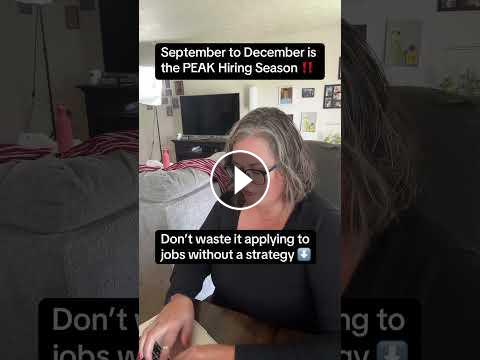
If you’ve been applying for weeks and barely getting interview calls, the problem probably isn’t your experience. It’s your job search strategy.
October through December can be a strong hiring window. Teams may have budgets to use before year-end and roles they want filled before the January rush.
Here’s how to actually use the next three months instead of randomly applying:
→ Pick 1–2 target roles.
Not “anything remote.” Specific job titles. Everything else gets easier once this is clear.
→ Rewrite your top bullets as results.
The first line under each job should highlight a recent accomplishment — ideally from the last couple of years — with a number attached whenever possible.
→ Apply where the crowd isn’t.
A lot of jobs appear on company career pages before they make their way to larger job boards like LinkedIn or Indeed. I recommend CareerHound.io because it pulls jobs directly from company career pages, so you can find opportunities closer to the source and potentially apply earlier, with less competition.
→ Apply early.
Sort by newest and prioritize recently posted jobs. The longer a listing has been up, the larger the applicant pool can become.
→ Send one real message per application.
Find the hiring manager when you can. Keep it short — two lines and something specific about the role or company.
→ Track everything.
Company, job link, application date, who you contacted, and status. Then look at what’s actually getting responses and double down on that.
Do this consistently for the next 90 days, and you can walk into January with a much stronger pipeline — instead of a spreadsheet full of silence.
Save this.
October through December can be a strong hiring window. Teams may have budgets to use before year-end and roles they want filled before the January rush.
Here’s how to actually use the next three months instead of randomly applying:
→ Pick 1–2 target roles.
Not “anything remote.” Specific job titles. Everything else gets easier once this is clear.
→ Rewrite your top bullets as results.
The first line under each job should highlight a recent accomplishment — ideally from the last couple of years — with a number attached whenever possible.
→ Apply where the crowd isn’t.
A lot of jobs appear on company career pages before they make their way to larger job boards like LinkedIn or Indeed. I recommend CareerHound.io because it pulls jobs directly from company career pages, so you can find opportunities closer to the source and potentially apply earlier, with less competition.
→ Apply early.
Sort by newest and prioritize recently posted jobs. The longer a listing has been up, the larger the applicant pool can become.
→ Send one real message per application.
Find the hiring manager when you can. Keep it short — two lines and something specific about the role or company.
→ Track everything.
Company, job link, application date, who you contacted, and status. Then look at what’s actually getting responses and double down on that.
Do this consistently for the next 90 days, and you can walk into January with a much stronger pipeline — instead of a spreadsheet full of silence.
Save this.
- Категория
- Удаленная работа

Комментариев нет.
Следующее
Auto
-
00:08

WFH girlies rise up #wfh #remotework
-
20:53
Ascending to a New Level of Peak Aesthetics | 25 Days Out
-
00:11
WFH Jobs #career #jobsearch #remotework #wfh #workfromhome #job #remotejobs #wfhjobs #fypシ #jobs
-
00:12
Peak remote work
-
00:24
Remote jobs that are always hiring with no interview#careerhound #remotejob #remotework #wfh
-
00:20
Five companies hiring remotely worldwide #wfh #remotework #workfromhome #remotejobs #goodonlinejobs
-
01:06
Save this to find your remote job!! #remotejob #wfh #wfhmom #remotework #hiring
-
05:49
The KEY To Peak Performance, in Brief
-
00:12
Remote jobs hiring without interviews. #wfh #remotework #workfromhome #jobsearch #careeradvice
-
00:14
Companies hiring remote and worldwide#careerhound #remotejob #remotework #wfh
-
00:21

Сайты для заработка | Заработок в интернете 2023
-
10:03
![Пассивный доход в 2024 с минимальным риском [Инструкция для новичков]](https://www.zarabotokonlinenovichkam.ru//uploads/thumbs/62170f5a8-1.jpg)
Пассивный доход в 2024 с минимальным риском [Инструкция для новичков]
-
06:33

Где найти подработку ЗА ОДИН ВЕЧЕР? Работа онлайн в 2024
-
00:54

Как новичку начать зарабатывать на трейдинге в 2024 году?
-
11:05

Как ЗАРАБОТАТЬ ШКОЛЬНИКУ в ИНТЕРНЕТЕ ? Самые Лёгкие Способы заработка денег в интернете 2024 !
-
13:39

Как зарабатывать с ТЕЛЕФОНА в 2024 году? Лучший, проверенный способ
-
34:57

Лучший интернет-бизнес для старта в 2024. (Для новичков)
-
01:00
Как майнить криптовалюту с телефона?Мобильный майнинг! 3$ за регистрацию!Заработок в интернете !
-
12:28

ФРИЛАНС с НУЛЯ в 2024 году| РЕАЛЬНО ли ЗАРАБОТАТЬ?
-
05:59

Как заработать на Pinterest? Бесплатный Трафик о котором никто не говорит.
 Загрузка...