

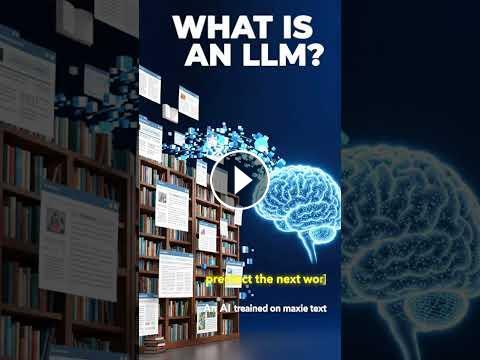
An LLM, or Large Language Model, is an artificial intelligence model designed to process and generate human-like text. LLMs are trained on large collections of text and other data to learn patterns in language. They can be used for tasks such as answering questions, summarizing information, translating languages, generating text, writing code, and supporting conversational AI applications. In this video, we explain what an LLM is, how it works, training, tokens, parameters, Transformers, inference, and common applications.
Large Language Models are a major part of modern Generative AI. They learn statistical patterns from training data and use those patterns to predict and generate sequences of tokens.
A token is a unit of information processed by a language model. Depending on the tokenizer, a token can represent a whole word, part of a word, punctuation, a number, or another piece of text. LLMs process sequences of tokens rather than directly processing complete sentences as humans do.
During training, an LLM is exposed to large amounts of data. The model adjusts its parameters to learn patterns and relationships within that data. Training can require substantial computing resources, datasets, specialized hardware, and carefully designed optimization processes.
Many modern LLMs use Transformer-based architectures. Transformers use attention mechanisms to process relationships between different tokens in a sequence. This helps the model use context when generating or interpreting text.
Parameters are numerical values learned during training. Large language models can contain very large numbers of parameters, although parameter count alone does not determine how capable a model is.
When a user provides a prompt, the LLM processes the available context and predicts possible next tokens. It generates a response by repeatedly selecting or sampling tokens until the response is completed or reaches a defined limit.
This process is called inference. Inference is different from training because the model is generally using its learned parameters rather than updating them through training.
LLMs can perform many language-related tasks. They can answer questions, summarize documents, translate text, rewrite content, generate ideas, explain concepts, assist with coding, classify information, and support conversational applications.
LLMs can also work with structured instructions. Developers can provide prompts that specify the task, format, tone, or other requirements. This practice is often called prompt engineering.
Some LLM applications can use external tools or information sources. For example, an AI application may connect a language model to search systems, databases, calculators, files, or other software. This can expand the capabilities of an application beyond the model's internal knowledge.
Retrieval-Augmented Generation, or RAG, is one method for providing relevant external information to an LLM. A RAG system retrieves relevant content and supplies it to the model as part of the context before generating a response.
LLMs have many applications in education, software development, customer service, research, content creation, business automation, and productivity. Their capabilities vary depending on the specific model, training, tools, and application.
LLMs also have limitations. They can generate incorrect information, misunderstand context, produce biased or incomplete outputs, and sometimes provide confident-sounding answers that are not accurate. Human review and verification are important when accuracy matters.
The quality of an LLM depends on many factors, including model architecture, training data, training methods, parameters, inference methods, evaluation, and the specific task.
An LLM is not the same thing as a chatbot. An LLM is the underlying AI model, while a chatbot is an application or interface that can use an LLM to communicate with users.
LLMs are also not automatically AGI. Large Language Models can perform many different tasks, but AGI is a broader concept referring to artificial intelligence with general-purpose capabilities across a wide range of tasks.
In this video, you will learn what an LLM is, Large Language Models, tokens, parameters, Transformers, attention, training, inference, prompts, prompt engineering, Generative AI, RAG, AI applications, benefits, limitations, and how modern language models work.
This explanation is designed for students, beginners, developers, AI learners, data science enthusiasts, and anyone interested in understanding the technology behind modern AI language systems.
Large Language Models are a major part of modern Generative AI. They learn statistical patterns from training data and use those patterns to predict and generate sequences of tokens.
A token is a unit of information processed by a language model. Depending on the tokenizer, a token can represent a whole word, part of a word, punctuation, a number, or another piece of text. LLMs process sequences of tokens rather than directly processing complete sentences as humans do.
During training, an LLM is exposed to large amounts of data. The model adjusts its parameters to learn patterns and relationships within that data. Training can require substantial computing resources, datasets, specialized hardware, and carefully designed optimization processes.
Many modern LLMs use Transformer-based architectures. Transformers use attention mechanisms to process relationships between different tokens in a sequence. This helps the model use context when generating or interpreting text.
Parameters are numerical values learned during training. Large language models can contain very large numbers of parameters, although parameter count alone does not determine how capable a model is.
When a user provides a prompt, the LLM processes the available context and predicts possible next tokens. It generates a response by repeatedly selecting or sampling tokens until the response is completed or reaches a defined limit.
This process is called inference. Inference is different from training because the model is generally using its learned parameters rather than updating them through training.
LLMs can perform many language-related tasks. They can answer questions, summarize documents, translate text, rewrite content, generate ideas, explain concepts, assist with coding, classify information, and support conversational applications.
LLMs can also work with structured instructions. Developers can provide prompts that specify the task, format, tone, or other requirements. This practice is often called prompt engineering.
Some LLM applications can use external tools or information sources. For example, an AI application may connect a language model to search systems, databases, calculators, files, or other software. This can expand the capabilities of an application beyond the model's internal knowledge.
Retrieval-Augmented Generation, or RAG, is one method for providing relevant external information to an LLM. A RAG system retrieves relevant content and supplies it to the model as part of the context before generating a response.
LLMs have many applications in education, software development, customer service, research, content creation, business automation, and productivity. Their capabilities vary depending on the specific model, training, tools, and application.
LLMs also have limitations. They can generate incorrect information, misunderstand context, produce biased or incomplete outputs, and sometimes provide confident-sounding answers that are not accurate. Human review and verification are important when accuracy matters.
The quality of an LLM depends on many factors, including model architecture, training data, training methods, parameters, inference methods, evaluation, and the specific task.
An LLM is not the same thing as a chatbot. An LLM is the underlying AI model, while a chatbot is an application or interface that can use an LLM to communicate with users.
LLMs are also not automatically AGI. Large Language Models can perform many different tasks, but AGI is a broader concept referring to artificial intelligence with general-purpose capabilities across a wide range of tasks.
In this video, you will learn what an LLM is, Large Language Models, tokens, parameters, Transformers, attention, training, inference, prompts, prompt engineering, Generative AI, RAG, AI applications, benefits, limitations, and how modern language models work.
This explanation is designed for students, beginners, developers, AI learners, data science enthusiasts, and anyone interested in understanding the technology behind modern AI language systems.
- Категория
- AI инструменты

Комментариев нет.
Следующее
Auto
-
08:10

Teach AI your Local Language and GET PAID | $24-40/HR (Here's How)
-
Understanding a great deal when you see one makes it easier for you to promote a product
-
16:18
✨SAGITTARIUS ♐️ - They Are Looking For You And Wondering What Happen? What Did They Do?
-
00:36
Understanding the Components of the Kit
-
08:26
Students Work from home jobs search कैसे kre? ये Modern तरीका कोई नही batayega। Pandey Guruji
-
18:39
Infosys Systems Engineer One Shot Prep | Infosys Systems Engineer Mock Test (Apti/Ver/Reasoning All
-
18:25
A billion particle collisions a second: How large particle colliders work | Don Lincoln
-
00:27
Obedience Before Understanding
-
08:37
Work From Home Job With TTEC: Understanding Call Listening & QA Roles
-
02:18
New tools, models, repos, and papers out of Microsoft Research are here. #ai #llm #github #agenticai
-
00:21

Сайты для заработка | Заработок в интернете 2023
-
10:03
![Пассивный доход в 2024 с минимальным риском [Инструкция для новичков]](https://www.zarabotokonlinenovichkam.ru//uploads/thumbs/62170f5a8-1.jpg)
Пассивный доход в 2024 с минимальным риском [Инструкция для новичков]
-
06:33

Где найти подработку ЗА ОДИН ВЕЧЕР? Работа онлайн в 2024
-
00:54

Как новичку начать зарабатывать на трейдинге в 2024 году?
-
11:05

Как ЗАРАБОТАТЬ ШКОЛЬНИКУ в ИНТЕРНЕТЕ ? Самые Лёгкие Способы заработка денег в интернете 2024 !
-
13:39

Как зарабатывать с ТЕЛЕФОНА в 2024 году? Лучший, проверенный способ
-
34:57

Лучший интернет-бизнес для старта в 2024. (Для новичков)
-
01:00
Как майнить криптовалюту с телефона?Мобильный майнинг! 3$ за регистрацию!Заработок в интернете !
-
12:28

ФРИЛАНС с НУЛЯ в 2024 году| РЕАЛЬНО ли ЗАРАБОТАТЬ?
-
05:59

Как заработать на Pinterest? Бесплатный Трафик о котором никто не говорит.
 Загрузка...