

You have moved in. You have watched where things land, followed your routines, adjusted rooms, shortened repeated paths, created places for unfinished tasks to pause, and built lower-capacity versions of the things that still need to work.
Now it is time to run the loop on your own home.
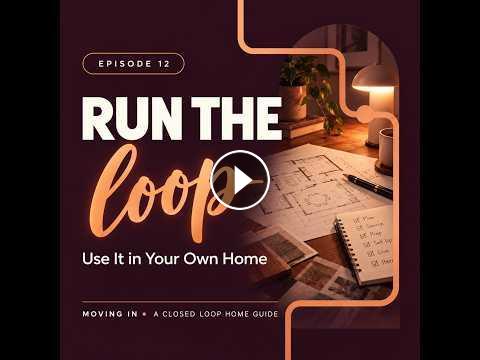
In this final episode of Moving In: A Closed Loop Home Guide, we bring the whole method together and use the Closed Loop Code to evaluate one real part of everyday life.
The Code is simple:
EVENT — What is actually happening?
NEED — What has to become possible?
FRICTION — Where does the sequence get harder?
SUPPORT — What can the environment carry?
EXIT — How can the event end without creating the next problem?
Then ask one separate question:
Does it still work at 20%?
The order matters.
EVENT keeps the problem specific. Instead of trying to “fix the kitchen,” you might look at unloading groceries, making coffee, or cleaning up after dinner.
NEED keeps the goal connected to the person using the home.
FRICTION helps you find the actual break in the routine instead of jumping straight to a product.
SUPPORT gives the environment responsibility for part of the work.
EXIT protects whatever happens next.
The 20% Test comes afterward because a system can look great on a good day and still depend on more energy, remembering, setup, maintenance, or motivation than you can reliably promise.
We also step back from individual rooms and look at the home as one connected day.
Morning affects leaving. Leaving affects arrival. Groceries affect cooking. Work affects rest. Bedtime affects tomorrow morning.
A home is not a collection of isolated rooms. It is a series of events and transitions that keep handing something to the next part of the day.
That is why the best solution is not always the biggest one.
Sometimes the useful change is turning the desk away from distracting movement, creating a landing surface where groceries actually enter, putting coffee supplies together around the sequence, moving a charger to the point of use, or giving bedtime one easy lighting transition.
Then test what you changed in real life.
Installation is not the finish line. The first solution is a hypothesis.
Did the repeated trip disappear? Did the surface stay usable? Did the support create another chore? Did someone else inherit the maintenance? Can you still use it on a lower-capacity day? Does it feel good enough to keep?
If the answer is no, that is not failure.
It is new information.
Move it. Simplify it. Duplicate it. Remove it. Change the visibility. Shorten the path. Try a smaller answer.
Revision is part of the method. A Closed Loop Home learns.
For your final exercise, choose one low-stakes routine and write one sentence for each part of the Code: Event, Need, Friction, Support, and Exit.
Then ask: Does it still work at 20%?
Keep the first experiment small enough to test.
You do not have to redesign your entire home at once. Follow one repeated behavior, find one place where the environment is asking too much, change one thing, and learn from what happens next.
Then run the loop again.
The loop is closed when the support carries you through the moment and leaves the next moment intact.
Moving In is a practical companion series based on the Closed Loop Home framework created by interior designer Crystal Bright.
The Closed Loop Home releases October 31st and goes deeper into open loops, the Closed Loop Code, the 20% House, point-of-need support, Activity Storage, Designed Staging States, visibility, transitions, consequence tails, and the full framework behind designing a home around the life that actually happens inside it.
Follow @theclosedloophome on Instagram, TikTok, and YouTube, and follow or subscribe wherever you listen.
Now it is time to run the loop on your own home.
In this final episode of Moving In: A Closed Loop Home Guide, we bring the whole method together and use the Closed Loop Code to evaluate one real part of everyday life.
The Code is simple:
EVENT — What is actually happening?
NEED — What has to become possible?
FRICTION — Where does the sequence get harder?
SUPPORT — What can the environment carry?
EXIT — How can the event end without creating the next problem?
Then ask one separate question:
Does it still work at 20%?
The order matters.
EVENT keeps the problem specific. Instead of trying to “fix the kitchen,” you might look at unloading groceries, making coffee, or cleaning up after dinner.
NEED keeps the goal connected to the person using the home.
FRICTION helps you find the actual break in the routine instead of jumping straight to a product.
SUPPORT gives the environment responsibility for part of the work.
EXIT protects whatever happens next.
The 20% Test comes afterward because a system can look great on a good day and still depend on more energy, remembering, setup, maintenance, or motivation than you can reliably promise.
We also step back from individual rooms and look at the home as one connected day.
Morning affects leaving. Leaving affects arrival. Groceries affect cooking. Work affects rest. Bedtime affects tomorrow morning.
A home is not a collection of isolated rooms. It is a series of events and transitions that keep handing something to the next part of the day.
That is why the best solution is not always the biggest one.
Sometimes the useful change is turning the desk away from distracting movement, creating a landing surface where groceries actually enter, putting coffee supplies together around the sequence, moving a charger to the point of use, or giving bedtime one easy lighting transition.
Then test what you changed in real life.
Installation is not the finish line. The first solution is a hypothesis.
Did the repeated trip disappear? Did the surface stay usable? Did the support create another chore? Did someone else inherit the maintenance? Can you still use it on a lower-capacity day? Does it feel good enough to keep?
If the answer is no, that is not failure.
It is new information.
Move it. Simplify it. Duplicate it. Remove it. Change the visibility. Shorten the path. Try a smaller answer.
Revision is part of the method. A Closed Loop Home learns.
For your final exercise, choose one low-stakes routine and write one sentence for each part of the Code: Event, Need, Friction, Support, and Exit.
Then ask: Does it still work at 20%?
Keep the first experiment small enough to test.
You do not have to redesign your entire home at once. Follow one repeated behavior, find one place where the environment is asking too much, change one thing, and learn from what happens next.
Then run the loop again.
The loop is closed when the support carries you through the moment and leaves the next moment intact.
Moving In is a practical companion series based on the Closed Loop Home framework created by interior designer Crystal Bright.
The Closed Loop Home releases October 31st and goes deeper into open loops, the Closed Loop Code, the 20% House, point-of-need support, Activity Storage, Designed Staging States, visibility, transitions, consequence tails, and the full framework behind designing a home around the life that actually happens inside it.
Follow @theclosedloophome on Instagram, TikTok, and YouTube, and follow or subscribe wherever you listen.
- Категория
- TikTok / Shorts заработок

Комментариев нет.
Следующее
Auto
-
13:09

We Overcomplicate ADV & Dual Sport Riding | Kings Mountain Loop
-
26:01
The Best AI Game Maker Now Works in a Loop Mode
-
43:19
3 Canva AI 2.0 Tricks Small Business Owners Can Use Today / The Shift AI Show: Episode 22
-
34:24
I'm a Senior Google AI PM. Here's How I Build Loops (Finally, Loop Engineering Explained)
-
08:11
3 Stylish DIY Earrings to Start Your Own Jewelry Business from Home .for Beginners.
-
01:04
Stop Overpaying: How to Use Agent OS to Run Your AI Tools for Free
-
01:14
From Kid Hauler to Grocery Getter | Flyer Loop | Cubby Kaboodle
-
21:31
You Can Learn Loop VS Graph Engineering In 21 Min | AI Agent System Design, Harness, Nodes, Edges
-
10:30
How to Use AI Tools to Study and Learn in School | CODE Along Season 5, Episode 8
-
14:42
AI Agent на React за 15 минут: Agent Loop, Tools и AI SDK с нуля
-
00:21

Сайты для заработка | Заработок в интернете 2023
-
10:03
![Пассивный доход в 2024 с минимальным риском [Инструкция для новичков]](https://www.zarabotokonlinenovichkam.ru//uploads/thumbs/62170f5a8-1.jpg)
Пассивный доход в 2024 с минимальным риском [Инструкция для новичков]
-
06:33

Где найти подработку ЗА ОДИН ВЕЧЕР? Работа онлайн в 2024
-
00:54
Как новичку начать зарабатывать на трейдинге в 2024 году?
-
11:05

Как ЗАРАБОТАТЬ ШКОЛЬНИКУ в ИНТЕРНЕТЕ ? Самые Лёгкие Способы заработка денег в интернете 2024 !
-
13:39
Как зарабатывать с ТЕЛЕФОНА в 2024 году? Лучший, проверенный способ
-
34:57

Лучший интернет-бизнес для старта в 2024. (Для новичков)
-
01:00
Как майнить криптовалюту с телефона?Мобильный майнинг! 3$ за регистрацию!Заработок в интернете !
-
12:28

ФРИЛАНС с НУЛЯ в 2024 году| РЕАЛЬНО ли ЗАРАБОТАТЬ?
-
05:59

Как заработать на Pinterest? Бесплатный Трафик о котором никто не говорит.
 Загрузка...